
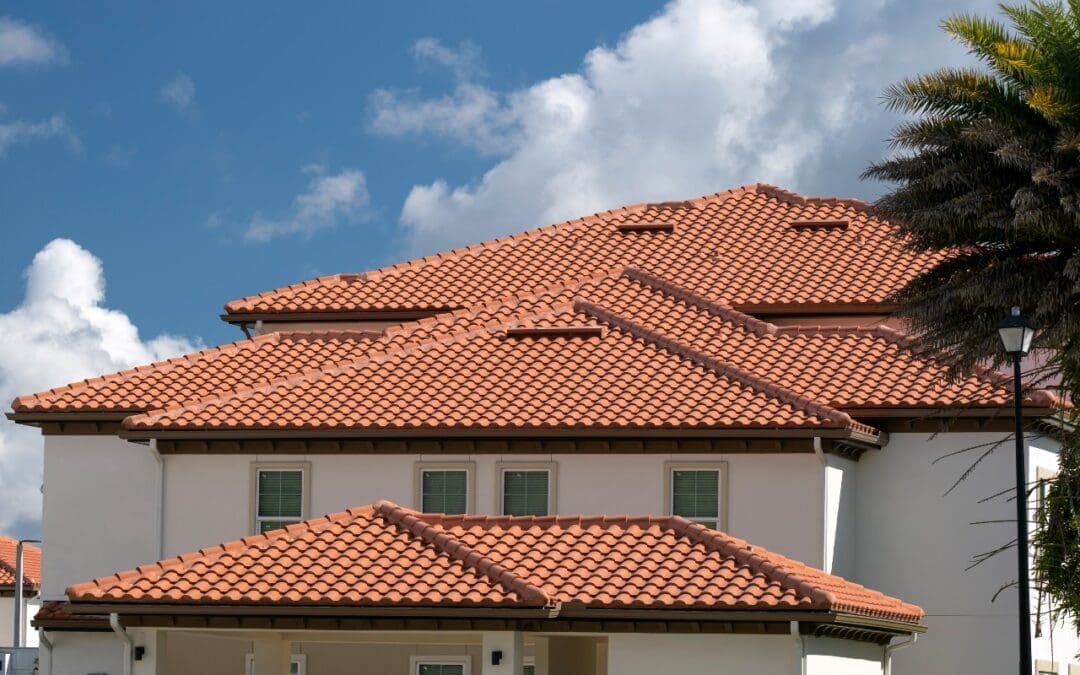
Mediterranean-style clay or concrete tile looks timeless, but many older roofs weren’t built for today’s wind loads, sealed-deck standards, or inspection requirements. A targeted retrofit in Florida can harden the structure, improve water tightness, and may help you qualify for wind-mitigation credits – without a full tear-off.
In this post, we’ll show you where older tile roofs typically fail, the retrofit steps that bring them up to modern code (tie-downs, underlayments, anchoring, and more), what to expect on cost, and how to document upgrades for potential insurance credits.
Where Older Tile Roofs Fail
- Hips & ridges: Mortar-only caps are a weak link. Current guidance calls for hip/ridge boards or metal and mechanical fasteners and/or approved tile adhesives – not mortar alone.
- Eaves/edges: Uplift is highest along edges; tiles without approved clips/fasteners or foam-adhesive attachment are more likely to dislodge and cascade.
- Roof-to-wall connections: Older homes may have basic toenails instead of clips/wraps. Upgrading connections materially improves uplift resistance and is recognized in Florida wind-mitigation inspections.
What Modern Retrofitting Involves
- Ridge and Hip Reinforcement: Remove existing caps, install/verify continuous ridge/hip boards or metal, then secure caps with approved mechanical fasteners and/or listed foam adhesives per Florida Product Approvals/NOAs.
- Eave Tile Anchoring: Install approved eave/field clips or mechanical fasteners to the roof deck/eave metal, or use listed two-part polyurethane foam adhesive systems to meet tested uplift for your exposure and roof geometry.
- Deck Re-Nailing: If existing sheathing has light or inconsistent nailing, adding 8d ring-shank nails at code spacing brings the substrate up to modern wind standards. Properly fastened decking stays attached even when tiles blow off.
- Structural Tie-Downs: Add hurricane clips or straps between roof trusses and wall plates to create a continuous load path. This upgrade is recognized on Florida wind-mitigation inspections and may reduce premiums; discount amounts vary by insurer
- Underlayment Upgrades: Use a sealed-deck approach – either full self-adhered ASTM D1970 or SA joint strips plus a compliant anchor sheet – to improve secondary water protection beneath tile.
Code, Documentation, and Credits Required
Your retrofitting work should be permitted and inspected to the current Florida Building Code.
A post-retrofit wind-mitigation inspection (Form OIR-B1-1802) can document improved roof-deck attachment, secondary water barrier, and roof-to-wall connections – items that may qualify many homes for insurance credits. Local roofing contractors frequently note meaningful premium reductions when these features are verified.
Cost Considerations
Total cost varies with access, tile salvageability, deck condition, connector count, and underlayment path.
The most budget-efficient gains typically come from roof-to-wall upgrades, deck re-nailing, and sealed-deck underlayments – improvements that protect even if individual tiles dislodge. A proper site evaluation is essential for an accurate scope and fair quote.
Trust Professional Roofers in Sarasota for a Code-Compliant Retrofit
Not every older tile roof needs a complete overhaul. Professional assessment identifies which retrofit measures your specific roof requires. Some installations used partial mechanical fastening that can be supplemented rather than replaced.
Bringman Roofing specializes in evaluating Mediterranean-style homes throughout Manatee and Sarasota counties. We document existing attachment methods, identify code deficiencies, and specify retrofit solutions scaled to your roof’s actual vulnerabilities and budget. Get in touch with our team for a detailed retrofit assessment. We’ll show you exactly what your roof needs to meet current code and withstand Gulf Coast weather.